
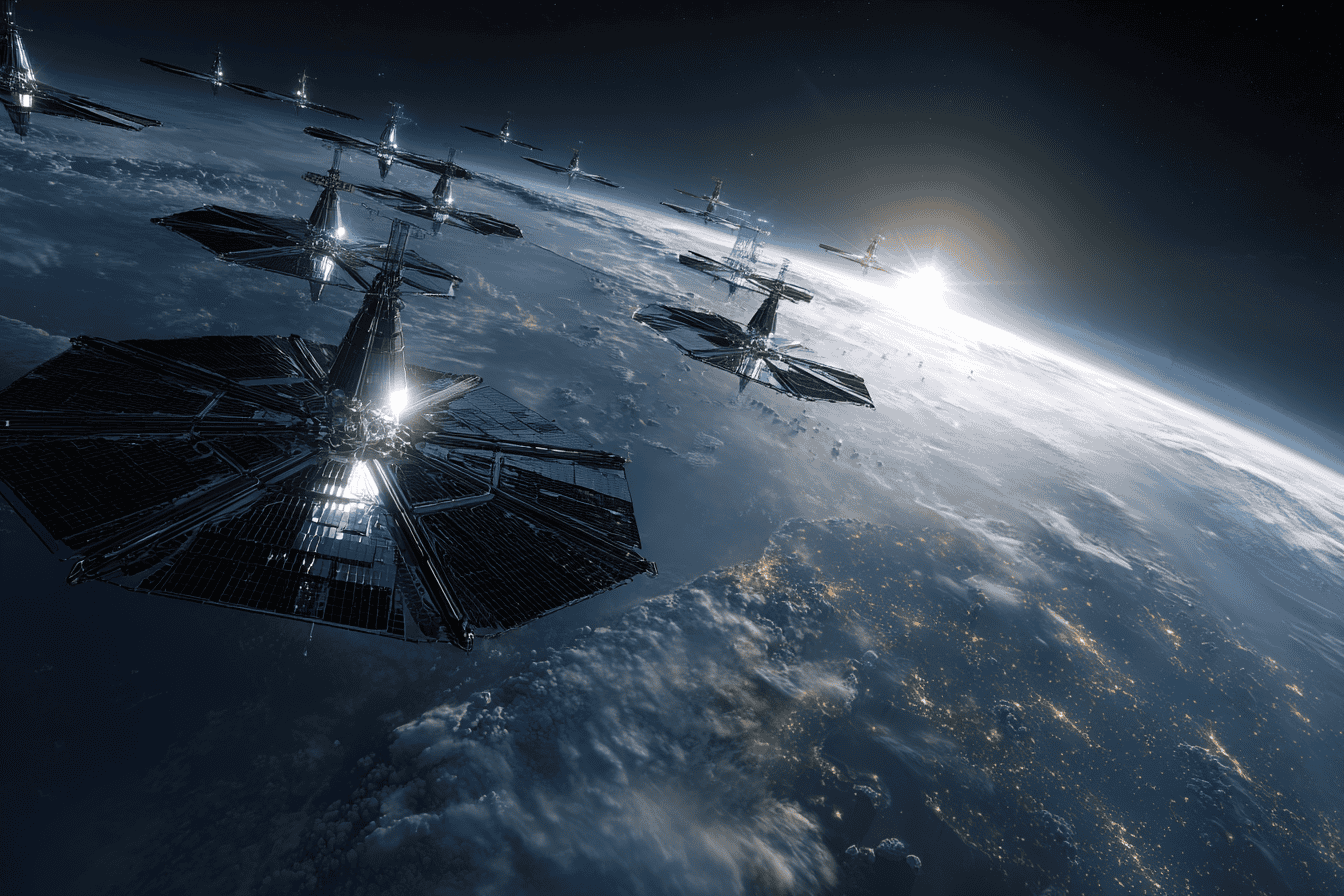
A recent study reveals that solar panels deployed in space could supply constant energy to Earth by 2050, significantly reducing energy costs in Europe. This innovative approach could decrease the continent’s reliance on battery storage by over 70%.
The concept of space-based solar power (SBSP) was originally proposed by engineer Peter Glaser in the late 1960s. He suggested launching large solar panels into orbit to capture solar energy and beam it back to Earth. At that time, the idea seemed far-fetched, akin to visions of lunar colonies or nuclear vehicles. Yet, the evolution of ground-based solar technology has proved similarly transformative. In the past decade, global solar power generation has jumped from 1% to over 7% of total electricity, making it one of the most cost-effective energy sources available.
Ground-based solar panels face challenges like weather variability, nighttime outages, and seasonal changes. Conversely, solar arrays situated 36,000 kilometers above the equator would benefit from nearly uninterrupted sunlight. Wei He, a senior lecturer in engineering at King’s College London and lead author of the study, emphasizes that solar panels in space could consistently face the sun, increasing power generation far beyond Earth’s daily cycles.
The study evaluated two NASA-designed SBSP concepts. The first, known as a heliostat swarm, utilizes thousands of reflective mirrors to concentrate sunlight onto a central collector. Although this design is currently technologically ambitious, it could achieve 99.7% annual energy availability. The second concept features a simpler planar array, resembling a large sheet of solar panels in orbit. While more feasible, it would capture sunlight only about 60% of the time.
In simulations of Europe’s energy grid for 2050, the heliostat swarm design emerged as a transformative force. It could replace large quantities of conventional wind and solar energy while reducing battery storage needs drastically. He states, “Space-based solar power is a viable technology that can offer continuous renewable energy.”
However, implementing this technology presents challenges. To transmit energy back to Earth, satellites would convert sunlight into microwaves and direct them to extensive receiving stations, known as rectennas. These stations, spanning several square kilometers, would connect to the electric grid. Although innovative rectenna designs may allow for some co-use of land, public opposition is likely due to concerns over microwave exposure.
Another challenge involves orbital congestion. As Wei He points out, “The risk of satellite collisions or damage from space debris is a significant concern.”
Cost remains a major barrier as well. Currently, the expenses associated with building and launching such systems are one to two orders of magnitude too high. For the heliostat design to be economically viable, costs must decrease to about 14 times the projected expense of terrestrial solar by 2050; the planar array design must reduce to approximately 9 times that cost.
Despite these challenges, Europe has advantages that could facilitate the development of SBSP. The continent boasts one of the most integrated electricity grids globally and a wealth of experience from multinational space projects under the European Space Agency. This combination could lead to a collaborative SBSP initiative that is both feasible and appealing. He asserts, “Now is the time.”
By 2050, if costs decline as expected, space solar technology could replace not only fossil fuels but also much of the land-based renewable energy infrastructure. This shift may lead to fewer wind turbines and solar farms across landscapes, as well as decreased dependence on extensive battery storage.
Other countries are moving forward with their own SBSP initiatives. Japan has integrated space solar power into its national energy and space strategy, while China, India, Russia, and the United States are also pursuing similar programs. Europe risks falling behind if it does not take action.
While the concept of extensive solar power stations in orbit may seem like science fiction, advancements in the economics of space are accelerating. Reusable rockets are lowering launch costs, and developments in orbital robotics are progressing. Even small-scale trials in wireless power transmission have shown success.
The study emphasizes that the time has come to take space solar power seriously. Initiating experiments, establishing policies, and assessing risks will prepare the groundwork for potential breakthroughs. If the technology matures, it could offer a clean, reliable energy source unaffected by weather conditions. As the researchers conclude, space-based solar is no longer merely a theoretical concept—it may soon become a reality.



 Arabic
  English