
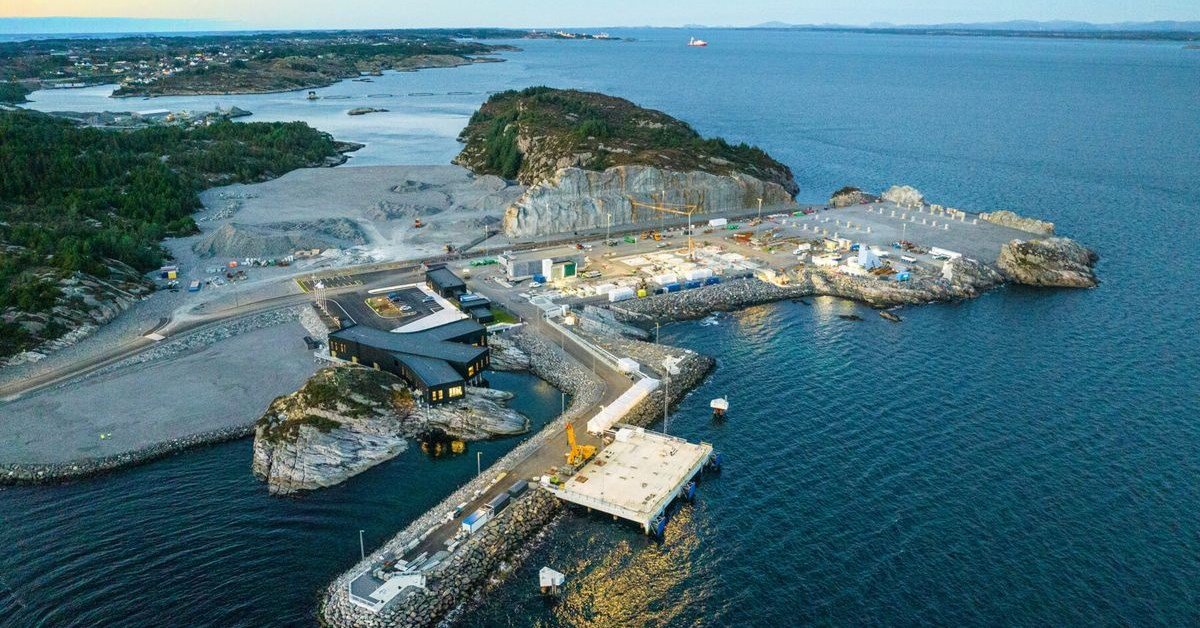
TotalEnergies, in collaboration with Equinor and Shell, has officially launched the Northern Lights project, the largest carbon capture and storage (CCS) initiative in Europe. This project marks a significant advancement in the global CCS landscape as it introduces the world’s first open-access CO₂ transportation and storage network.
The inaugural phase commenced with the successful injection of carbon dioxide beneath the seabed off the western coast of Norway. The first shipment of CO₂ was sourced from Heidelberg Materials’ cement plant located in Brevik, Norway, which features a pioneering carbon capture facility. This facility has the capacity to capture 400,000 tonnes of CO₂ annually, producing ‘evoZero’ cement, marketed as a low-carbon alternative.
The captured CO₂ was transported via ship to a new terminal at Øygarden and then delivered through a 100-kilometer pipeline, where it was injected over 2,600 meters below the seabed. This initial phase of the Northern Lights project will allow for the storage of up to 1.5 million tonnes of CO₂ per year. Notably, this capacity has already been fully booked by several industrial clients across Europe.
Plans for further expansion are underway. By March 2025, the project partners approved a second phase, which aims to increase annual storage capacity to over 5 million tonnes by 2028. This expansion will necessitate significant infrastructure development, including additional tanks, pumping systems, injection wells, and transport vessels.
Northern Lights has established contracts with five major industrial companies: Heidelberg Materials and Hafslund Celsio from Norway, Yara from the Netherlands, Ørsted from Denmark, and Stockholm Exergi from Sweden. These partnerships are crucial for helping these firms reduce emissions from sectors that are traditionally hard to decarbonize, such as cement production, waste-to-energy conversion, and chemical manufacturing.
Arnaud Le Foll, Senior Vice-President for New Business – Carbon Neutrality at TotalEnergies, emphasized that the successful CO₂ injection signifies a new phase for the CCS sector in Europe. The project is supported by Norway’s Longship initiative, which provides substantial government funding. This initiative reflects the Norwegian government’s commitment to establishing CCS as a commercially viable industry essential for Europe to achieve its climate objectives.
The innovative carbon capture technology employed by Heidelberg at its Brevik plant is the first of its kind in the cement industry. The facility’s ability to capture substantial quantities of CO₂ is a game changer, as demand for the 2025 output of ‘evoZero’ cement is already pre-sold.
However, challenges remain in scaling up CCS operations. Experts warn that ongoing investment, supportive regulatory frameworks, and enhanced carbon pricing are necessary to ensure that low-carbon products can compete effectively in the market. Without these measures, the viability of projects like Northern Lights may rely heavily on public subsidies and face difficulties in broader implementation.
The launch of Northern Lights represents a critical turning point in emissions management. For the first time, industrial CO₂ is being transported and permanently stored across borders on a large scale. If successful, Northern Lights could serve as a blueprint for similar initiatives across Europe and globally, aiming to mitigate emissions from industries that are not easily transitioned to renewable energy sources.

 Arabic
  English