
As the global appetite for sustainable energy solutions rises, 2025 is set to introduce over 45 new funding opportunities targeting clean energy innovation. This surge in financial backing aims to support technologies that reduce carbon emissions and promote environmental sustainability.
Various government initiatives and private sector investments are leading this charge. For instance, the U.S. government has allocated an additional $3 billion for renewable energy research, focusing on solar, wind, and energy storage technologies. This funding is part of a broader strategy to achieve net-zero emissions by 2050, which has already spurred significant advancements in various sectors.
In Europe, countries like Germany and France are rolling out grant programs worth over €5 billion combined to support startups in the clean energy space. These programs are designed to encourage innovation in energy efficiency, electric vehicle infrastructure, and green hydrogen production. Notably, the German government reported that these investments could create up to 30,000 jobs in the clean energy sector by 2026.
Private funding is also on the rise, with venture capital firms investing more than $10 billion in clean energy startups in 2025 alone. This influx of capital is expected to accelerate the development of breakthrough technologies, such as advanced battery systems and carbon capture solutions. Investors are particularly interested in companies that demonstrate a clear path to scaling their technologies and achieving profitability.
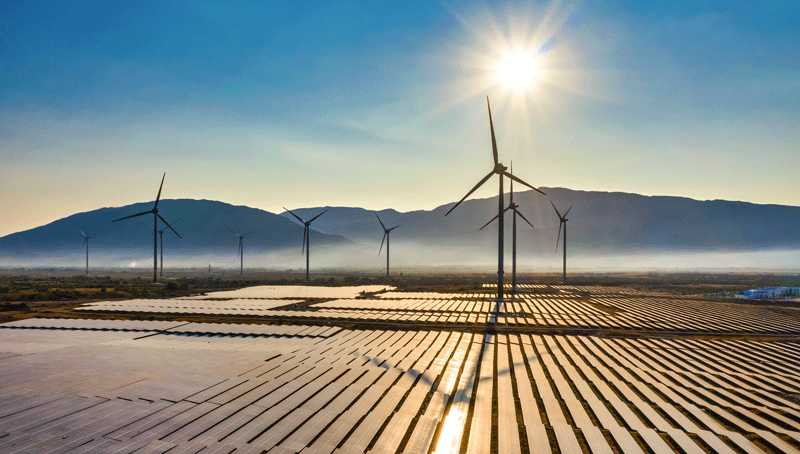
Additionally, public-private partnerships are emerging as a key strategy to finance large-scale renewable energy projects. For example, a new coalition between technology firms and local governments aims to develop a network of solar farms across the Midwest, projected to generate 5 gigawatts of electricity by 2027. This collaboration illustrates how different sectors can pool resources to meet energy demands while advancing sustainability goals.
Furthermore, non-profit organizations are increasingly stepping in to facilitate funding for clean energy initiatives. These organizations are focused on channeling donations and grants toward projects that help underserved communities access renewable energy technologies. A recent initiative raised $1 million to provide solar panel installations for low-income households, enhancing energy access and reducing utility bills.
The clean energy landscape in 2025 reflects a significant shift in funding dynamics, with diverse sources of capital fueling innovation. As these funding paths open up, they promise to accelerate the transition towards a more sustainable energy future, ensuring that clean energy solutions are not only available but also economically viable.

 English
  Arabic